Disclaimer: This is a thematic research note for informational purposes, not personalized investment advice. Markets carry risk; readers should do their own due diligence or consult a SEBI-registered advisor before acting. Geopolitical assumptions referenced below (e.g., an active US–Iran conflict) should be cross-checked against current news, as this note does not independently verify live eve
More Than Just a Lubricant Player
Retail investors often bucket Savita Oil Technologies with run-of-the-mill automotive lubricant companies. That’s a mispricing waiting to happen. Savita’s real engine sits deep inside India’s power grid — its Transol brand is a market leader in transformer oils, making the company a direct, under-the-radar proxy for the buildout of India’s power transmission, distribution, and renewable energy infrastructure.
The Core Premise : Why Now
- Power Grid Tailwind — Domestic capex in power infrastructure plus surging data center cooling demand is driving structural growth in high-grade transformer oils and advanced ester fluids.
- Volume Milestone — FY26 saw Savita cross 5 lakh KL (500,000 KL) in sales volume for the first time, up 17% YoY.
- Premiumization — Savsol Ester5, the B2C tech-backed lubricant range, grew at 5x the industry average in FY26.
- Global Reach — Exports now span 75+ countries, reducing reliance on domestic cyclicality.
- The Replacement Super-Cycle — Power transformers installed across the US and Western Europe in the 1970s–80s (30–40 year design life) are now overdue for replacement. Grid modernization mandates in developed markets are creating export demand for exactly the specialty products Savita already manufactures at globally competitive cost.
- The Tech Pivot — Savita is shifting from mineral transformer oils toward synthetic and natural ester fluids, opening two high-margin frontiers:
- Data centers: immersion cooling fluids for AI-driven server racks, cutting cooling energy use by up to 90%.
- EVs: dielectric fluids for direct-contact battery cooling in 800V+ architectures, improving fire safety and thermal management.
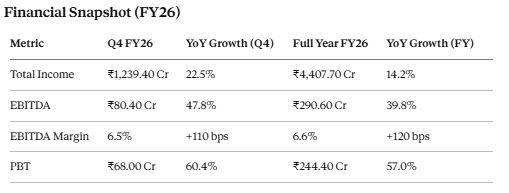
The key number: a 14.2% revenue increase translated into a 57% jump in PBT — clear evidence of operating leverage kicking in as base oil costs stabilized
The Near-Term Risk: Oil Price Shock from Geopolitical Tension
Savita’s raw material — base oil — is a crude derivative. When crude oil prices spike, Savita’s costs go up before it can raise its own prices. An immediate pass-through to customers is unlikely, but it shouldn’t take a full two quarters either — so expect the margin squeeze to show up quickly and correct faster than a typical cost cycle, likely within a quarter. Crude has reportedly risen over 15% in the past week, likely linked to US–Iran tensions. That’s a large, fast move. It means:
- Margins will likely take a hit in the near term, until pricing catches up.
- The stock could fall more than the usual 5–7% dip — possibly into double digits if crude stays high.
Why this isn’t a reason to sell, if you’re a long-term investor:
- Savita has passed through cost spikes before, and reasonably fast. FY26 margins actually expanded despite input cost swings earlier in the year.
- Demand isn’t going anywhere. Grid replacement, data centers, and EV adoption keep growing regardless of a short-term oil spike.
- Valuation gives room. Savita trades at a reasonable P/E (historically low 20s), cheaper than comparable B2C lubricant/FMCG names with similar tailwinds.
A Simple Accumulate-on-Dip Framework
Since this crude spike is bigger than usual, the message is simple: accumulate at every dip.
If the stock falls 5–7% on this oil price shock, buy your first tranche. If crude stays elevated and the stock slips another 10–15%, buy again — don’t wait for a bottom. Each fall driven by this cost pressure is a buying opportunity, not a reason to exit, as long as the demand story stays intact: keep an eye on quarterly volume growth. If margins dip in the results but volumes are still growing, that confirms it’s just a pricing lag, and you should keep buying on weakness. The one thing that would change this view is if volume growth itself slows down alongside the margin pressure — that would point to a demand problem, not just a cost problem, and would be the moment to pause and reassess. Once crude cools off and margins normalize, hold your accumulated position rather than chasing any sharp rally.
Risks & Monitorable
- Base oil volatility — Sudden crude spikes can compress margins before pass-through catches up.
- Working capital cycles — Heavy institutional exposure (utilities, state electricity boards) makes receivables and inventory tracking critical to watch each quarter.
- Execution risk on the ester pivot — Data center and EV fluid revenue is still early-stage; scaling timelines could slip.
Bottom Line
Savita isn’t a lubricant stock — it’s a transformer-oil-to-ester-fluid infrastructure play riding three converging tailwinds: India’s power buildout, the Western grid replacement cycle, and the AI/EV cooling boom. With crude reportedly up 15%+ in the past week on geopolitical tensions, near-term margin pressure and a sharper-than-usual stock pullback are plausible. For long-term investors, that’s where staggered accumulation — not an exit — makes sense, provided volume growth continues to hold up in the interim